Key Takeaways
- Storm damage can be hidden in the canopy, trunk, or root system.
- Hanging limbs, new limbs, trunk splits, and lifted roots deserve prompt attention.
- Never approach or attempt to move a tree touching a power line.
- Wet, saturated soil can reduce a mature tree’s stability after a storm.
- Some trees can be preserved through pruning or structural support instead of removal.
- A professional assessment helps separate manageable damage from an urgent hazard.
Table of Contents
- Introduction
- Why Post-Storm Tree Checks Matter
- First Steps After Severe Weather
- Six Warning Signs to Watch For
- Trees and Power Lines
- Repair, Support, or Removal?
- When Professional Help Is Needed
- Reducing Risk Before the Next Storm
- Chesapeake Soil and Weather Conditions
Thunderstorms, tropical systems, heavy rain, and strong coastal winds can quickly turn an ordinary Chesapeake yard into a hazard zone. Before beginning cleanup, take time to assess trees from a safe distance. For a careful on-site evaluation, tree service Chesapeake, VA provider 757 Tree Solutions offers arborist-led residential and commercial tree care, including removal, trimming, pruning, stump grinding, crane-assisted work, emergency response, and preservation services. Based in Chesapeake and serving nearby Suffolk and Virginia Beach, its team evaluates tree structure, root stability, surrounding targets, and practical long-term options.
Storm damage is not always obvious. A branch may be broken but still caught high in the canopy, roots may loosen below the soil surface, or a small trunk crack may widen after the next period of rain. Treat a damaged tree as unstable until its condition is clear.
Why Post-Storm Tree Checks Matter in Chesapeake
Chesapeake trees face repeated stress from wind, intense rainfall, saturated ground, and humid growing conditions. Mature trees may show damage as broken limbs, cracked trunks, torn bark, root movement, or a newly visible lean. The City’s storm tree safety advice identifies cracks at trunk forks, significant cavities, rot, and fungi near the base as important warning signs. A tree can look mostly intact from one side while carrying a serious structural defect on the other.
The First Steps to Take After Severe Weather
Start with safety, not cleanup. Walk the property only when conditions allow, remain outside the fall zone of damaged trees, and avoid standing beneath broken branches. A quiet yard is not necessarily a safe yard. Limbs can remain suspended overhead, and weakened roots may shift as soil dries or receives additional rain.
- Look for downed wires and stay well away from them.
- Check whether a tree has contacted a home, vehicle, fence, or utility line.
- Keep children, pets, and visitors away from damaged areas.
- Photograph visible damage from a safe location for insurance or assessment purposes.
- Contact the utility company, emergency services, insurer, or tree professional as appropriate.
Six Tree Warning Signs to Look For
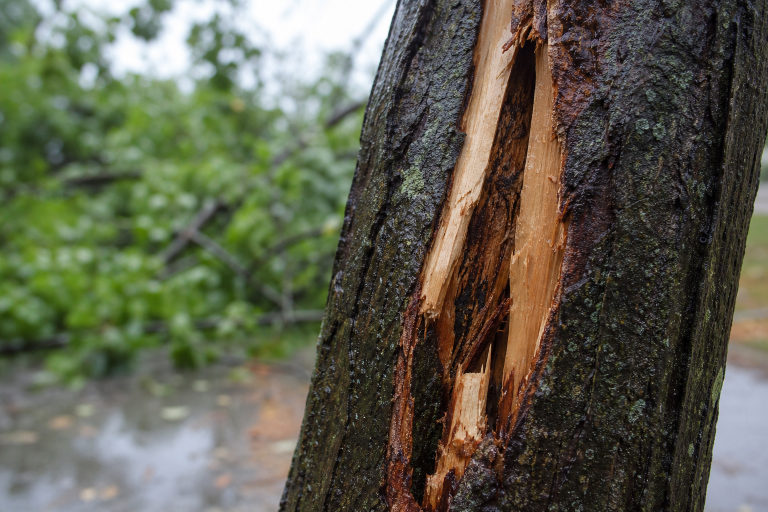
- Fresh trunk cracks: New splits may indicate that the trunk is separating or carrying unusual stress.
- Hanging limbs: Broken branches over roofs, walkways, driveways, and play areas can fall without warning.
- Exposed or lifted roots: Soil mounding, root heaving, or a raised root plate can signal a loss of anchoring.
- A new or worsening lean: A tree that changed position after wind or rain should be assessed promptly.
- Loose bark or deep cavities:These symptoms can reveal decay and reduced strength inside the trunk.
- Split branch unions: Forked stems with a visible seam are more vulnerable when wind loads the canopy.
What to Do When a Tree Touches a Power Line
Never cut, pull, climb, or try to move a tree that is touching or close to an electrical line. Keep everyone out of the area, assume the line may be energized, and contact the utility provider for instructions. Wet ground, damaged structures, metal tools, and electricity create a particularly dangerous combination during storm cleanup. Tree work should wait until the utility confirms that conditions are safe.
Should the Tree Be Repaired or Removed?
The right answer depends on species, size, location, root condition, structural damage, and the tree’s likely future performance. Removal is not the automatic solution. The goal is to reduce risk while preserving healthy, valuable trees when practical.
Pruning May Be Suitable When
- Damage is limited to several branches.
- The trunk is sound, and the root system remains stable.
- Broken wood can be removed without leaving a badly unbalanced canopy.
Cabling or Bracing May Be Considered When
- A mature tree has weak branch unions or competing stems.
- The tree has meaningful landscape value and remains otherwise healthy.
- Structural support, paired with monitoring and pruning, can limit movement.
Removal May Be the Safer Choice When
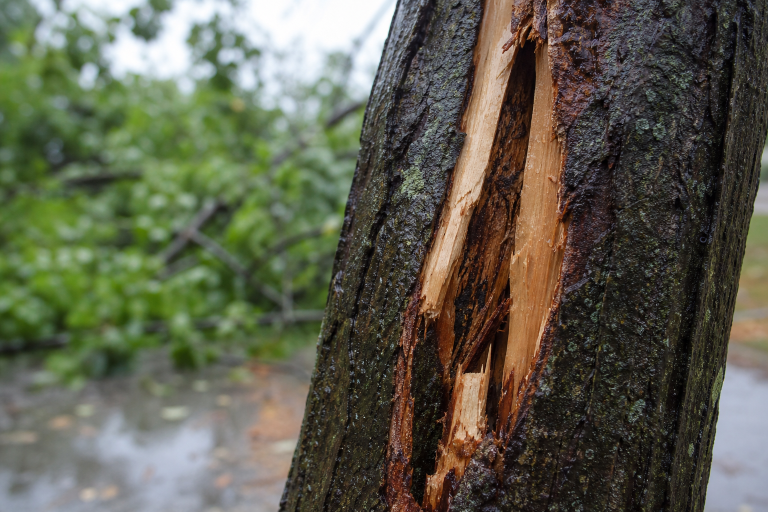
- The trunk has a major split or advanced decay.
- The root plate has shifted, lifted, or failed.
- The tree threatens a structure, road, utility line, or heavily used area.
When to Call a Chesapeake Tree Professional
Do not make storm-damaged trees a do-it-yourself project when a tree is on a roof, a large limb is suspended over a driveway, a trunk is leaning toward a home, or a damaged canopy is near a busy commercial property. These situations may require controlled rigging, specialized equipment, or crane-assisted removal. An experienced assessment can also identify trees that should be monitored rather than immediately removed.
How to Reduce Storm Risk Before the Next Event
- Perform routine visual checks of mature trees and their root zones.
- Remove dead, diseased, or poorly attached branches before storm season.
- Consider roofs, driveways, play spaces, and utility lines as trees grow.
- Watch for drainage problems and soil movement around large trees.
- Keep insurance information and emergency contacts accessible.
- Avoid topping trees, which can stimulate weak, poorly attached new growth.
Why Chesapeake Soil and Weather Conditions Matter
Local conditions affect how trees respond to storms. Saturated soil can reduce root anchorage, while wind can place extra force on tall, dense, or uneven canopies. Drainage patterns, waterfront-adjacent locations, mature neighborhoods, and tight spaces near homes all influence the safest approach. Virginia’s guidance for storm-resilient trees also emphasizes monitoring for damage to roots, bark, and trunks, using proper pruning, and selecting regionally adapted tree species when planting.
A Safer Way Forward
After a Chesapeake storm, pause before acting. Identify immediate hazards, stay clear of electrical risks and unstable trees, and seek a qualified assessment when damage is significant. The next step may be pruning, support, monitoring, or removal. Sound decisions protect people and property while giving healthy trees the best chance to remain part of the landscape.